Starknet, the Quantum Moat
The countdown for the cryptography securing all of crypto has already begun, and nation-states are weaponizing quantum computing

There is an old chart that statisticians love. It tracks the well-being of a Thanksgiving turkey over a thousand days. Every single day, the line goes up: the farmer feeds the turkey, the turkey grows, life is demonstrably good. Then comes day 1,001, and the line drops to zero in a single vertical stroke.
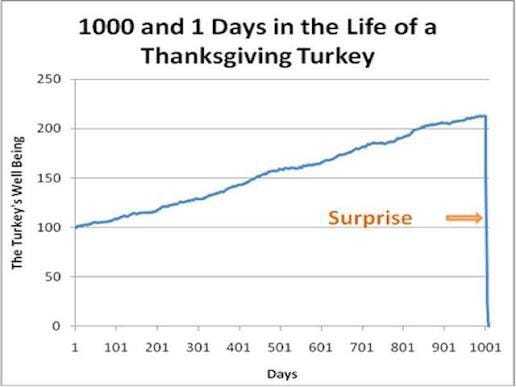
Crypto, today, is the turkey. For years, the narrative around quantum computers has been: we have time, this is a problem for 10 to 15 years from now. The issue was that nobody put a clear date on it. But now our turkey’s day 1,001 is known, coming from a rare consensus among governments, Big Tech, researchers, all converging on a single date: 2029. And most of the crypto world is not ready for it.
Most blockchains will need to rebuild critical parts of their architecture from scratch.
But not Starknet.
Starknet was built with quantum risk in mind from day one. The foundation is already there; now it only needs to complete the transition.
This article will show you:
Why quantum computing is a real threat
Why it may arrive sooner than most people think
Why quantum computing does not threaten Starknet’s future, but highlights the strength of its design

The catalyst: nation-states have become quantum investors
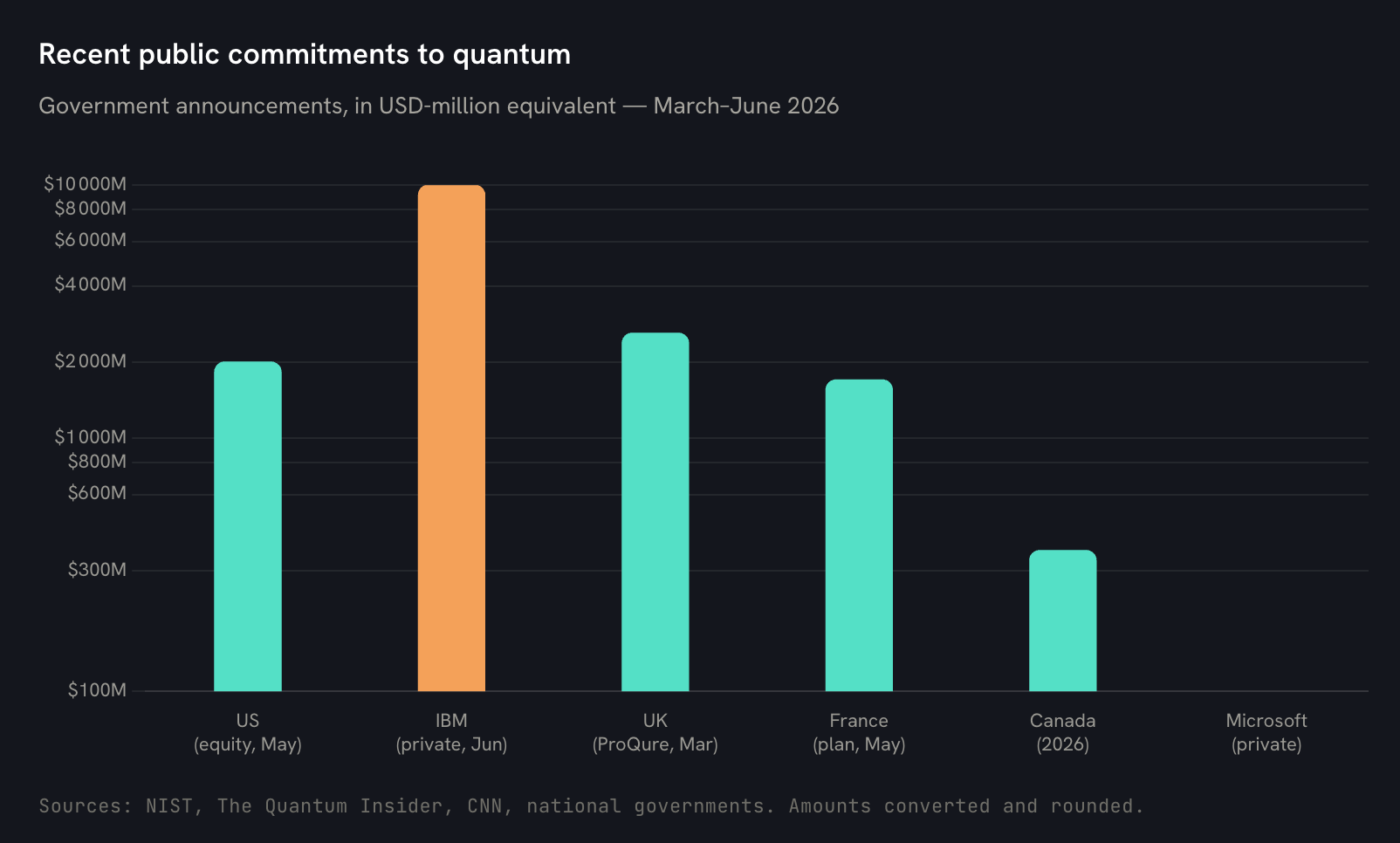
In the span of a few weeks in spring 2026, public funding of quantum computing changed in nature. It shifted from arm's-length research grants to direct government equity stakes. When a government takes equity, it is betting on a technology it sees as imminent, strategic, and disruptive.

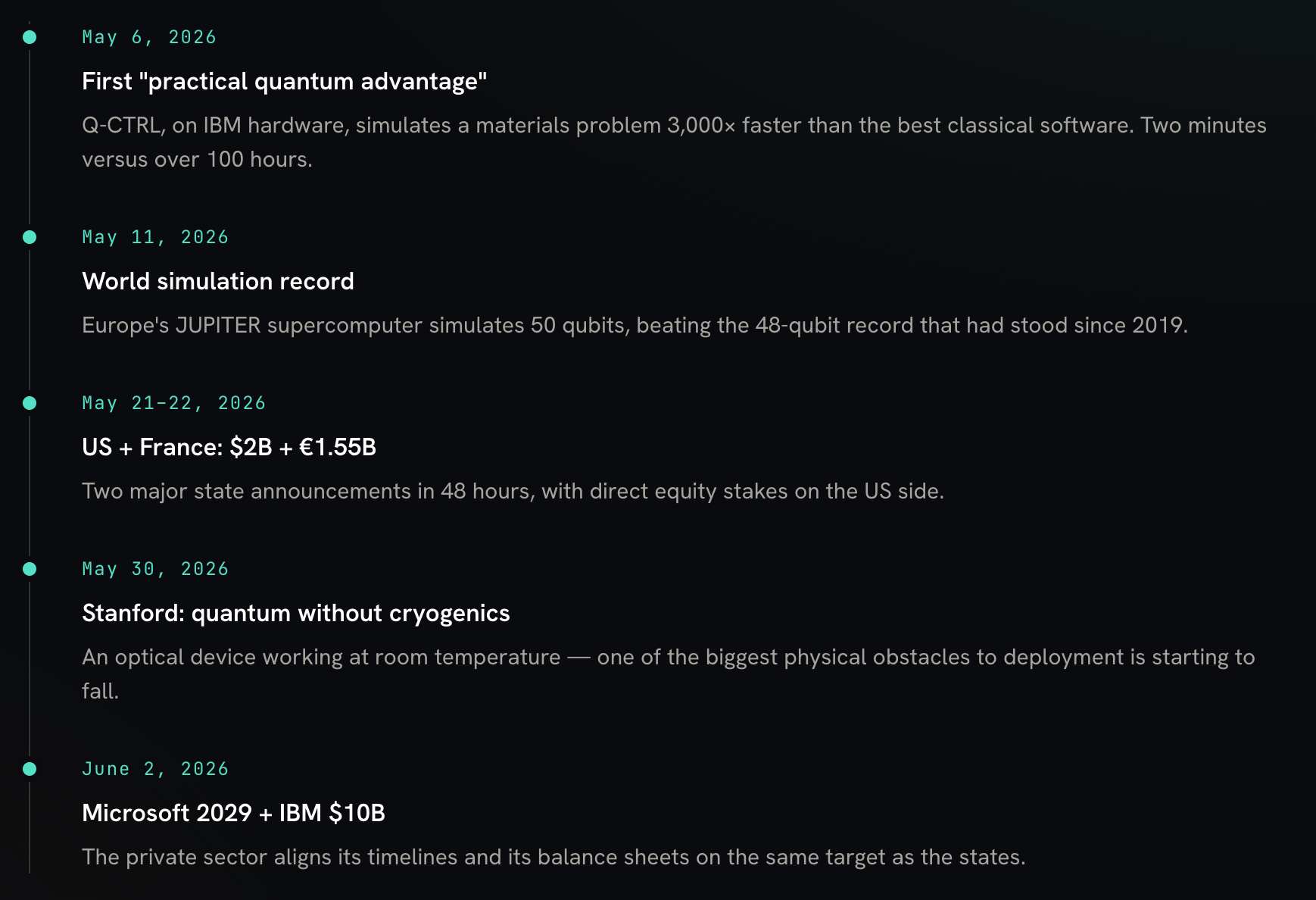
On May 21, 2026, the US Department of Commerce announced letters of intent for $2.01 billion across nine quantum companies, in exchange for a minority, non-controlling equity stake in each. This is neither a research contract nor a procurement deal. The federal government has become, structurally, a venture investor in the quantum sector.
The very next day, Emmanuel Macron, French president, announced from the CEA an additional one billion euros for the national quantum plan, explicitly citing “the acceleration of the United States and China” as the driver. Two of the world’s largest economies acted within twenty-four hours of each other.
And they are not alone:
Canada’s commitments,
a renewed surge of large funding rounds in China’s quantum sector complete the picture
Over $5 billion in public commitments announced in recent months! A real state-led race unfolding before our eyes.
The private sector then reinforced this momentum, and the most striking signal is the convergence of timelines. On June 2, 2026, Microsoft unveiled its Majorana 2 chip, claiming qubit reliability improved by a factor of 1,000, with qubit lifetimes jumping from milliseconds to around 20 seconds. On the strength of it, Microsoft cut its timeline for a scalable quantum computer from 2033 to 2029. The very same day, IBM announced an investment of more than $10 billion over five years, targeting its first large-scale fault-tolerant quantum computer by, again, 2029. And Google had already set its own internal deadline to migrate its infrastructure to post-quantum cryptography by, once more, 2029.
And if it was not enough, on June 22, 2026, one month after the Commerce stakes, President Trump signed two quantum executive orders on the same day. The first, “Ushering in the Next Frontier of Quantum Innovation”, launches a national effort to build a government-scale quantum computer (the QC-ADDS Effort) and directs the intelligence community to assess the national security implications of increasingly powerful commercial quantum machines, explicitly naming the migration to post-quantum cryptography. The second, “Securing the Nation Against Advanced Cryptographic Attacks,” is the one that matters most here: it orders an accelerated, government-wide migration to post-quantum cryptography, with federal agencies required to transition high-value assets by 2030 and 2031 and a Commerce pilot due by the end of 2027.
In thirty days, the same governments moved on every front at once: taking equity in quantum companies, funding national champions, racing to build the machine, and mandating defense against it. You do not order a costly migration against a threat you believe is twenty years away.
The main takeaway here is that when governments take equity in quantum companies, race to build the machine, and order their own defenses against it, all while the two biggest quantum players name the same year days apart, the risk profile has changed.
The reality is that quantum risk is approaching faster than crypto markets have priced in.
The threat: what breaks in crypto
To understand what a quantum computer does to cryptography, picture a giant maze. The exit is your private key.
A classical computer walks the corridors one by one. Since there are more paths than atoms in the universe, it will never get out. That impossibility is your security.
On the other side, a quantum computer doesn’t walk the maze. It notices that the maze was built by repeating the same pattern over and over, and from that repeating structure, it computes directly where the exit is.
That, in essence, is Shor’s algorithm applied to elliptic-curve cryptography (ECC): the math behind Bitcoin signatures, Ethereum accounts, and nearly every wallet in crypto.
A sufficiently powerful quantum computer, via Shor’s algorithm, can derive a private key from an exposed public key: what secures a wallet today would become, once the public key is exposed, an open lock.
For years this threat stayed theoretical and distant, the eternal “twenty years away.” What changed in 2025 and 2026 is that the estimated resources required collapsed, paper after paper, from the researchers who actually build quantum hardware.
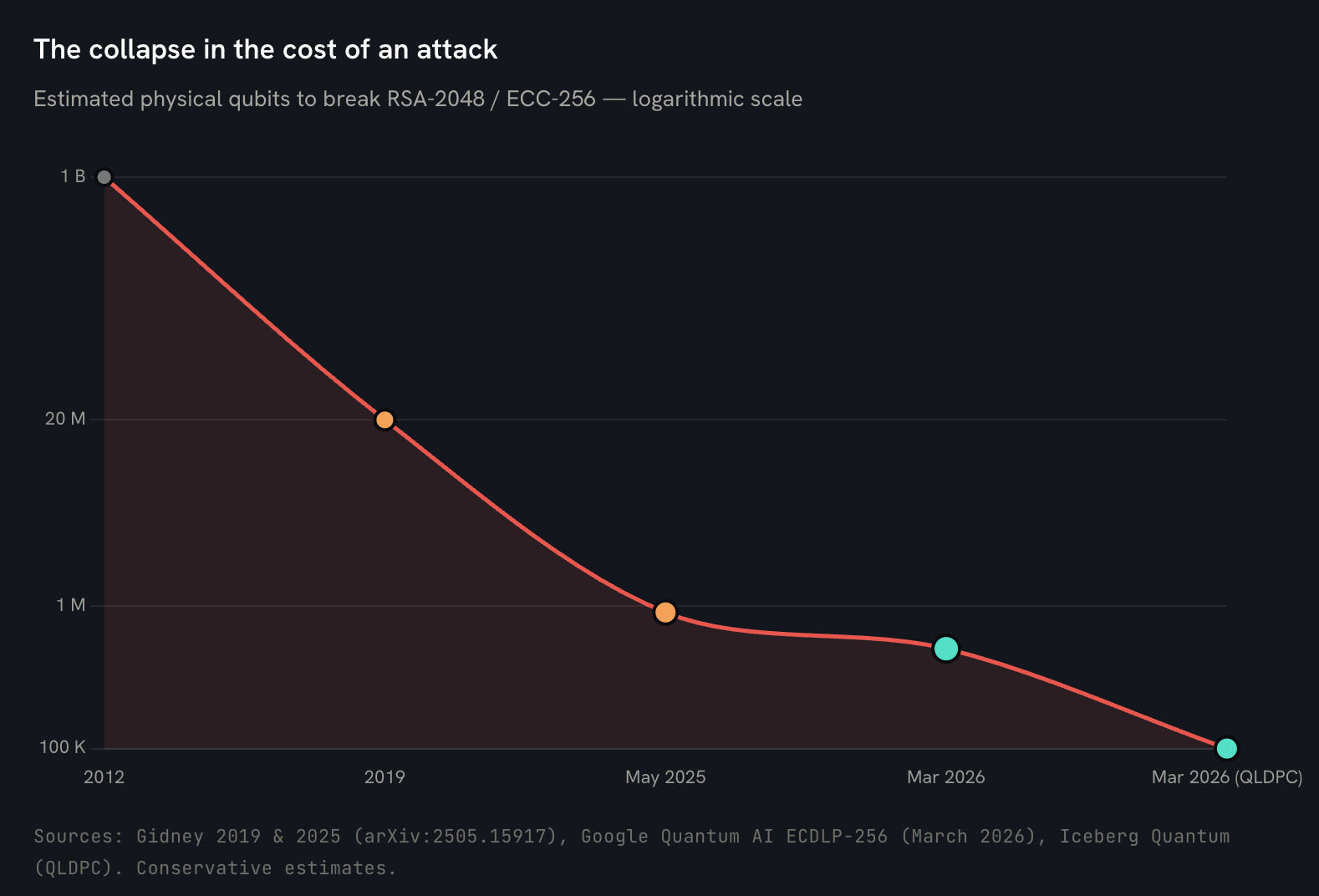
In 2012, breaking RSA-2048 was estimated to require roughly one billion physical qubits. In May 2025, Google Quantum AI researcher Craig Gidney published a revised estimate: fewer than one million qubits, in under a week. That is a compression of about 1,000 times in thirteen years, drawn not from commercial promises but from public papers built on the same surface-code framework that underpins modern post-quantum risk assessments.
RSA is not what secures most blockchains today. ECC is.
And that is exactly where the strongest signal came from: in March 2026, Google Quantum AI, with researchers from the Ethereum Foundation and Stanford, published new estimates for breaking ECDLP-256, the core problem underlying the ECC signatures used by Bitcoin, Ethereum, and many wallets.
Their estimate: fewer than 500,000 physical qubits, or roughly 1,200 to 1,450 logical qubits.
Around the same time, Google also introduced a 2029 timeline to migrate its own systems to post-quantum cryptography.
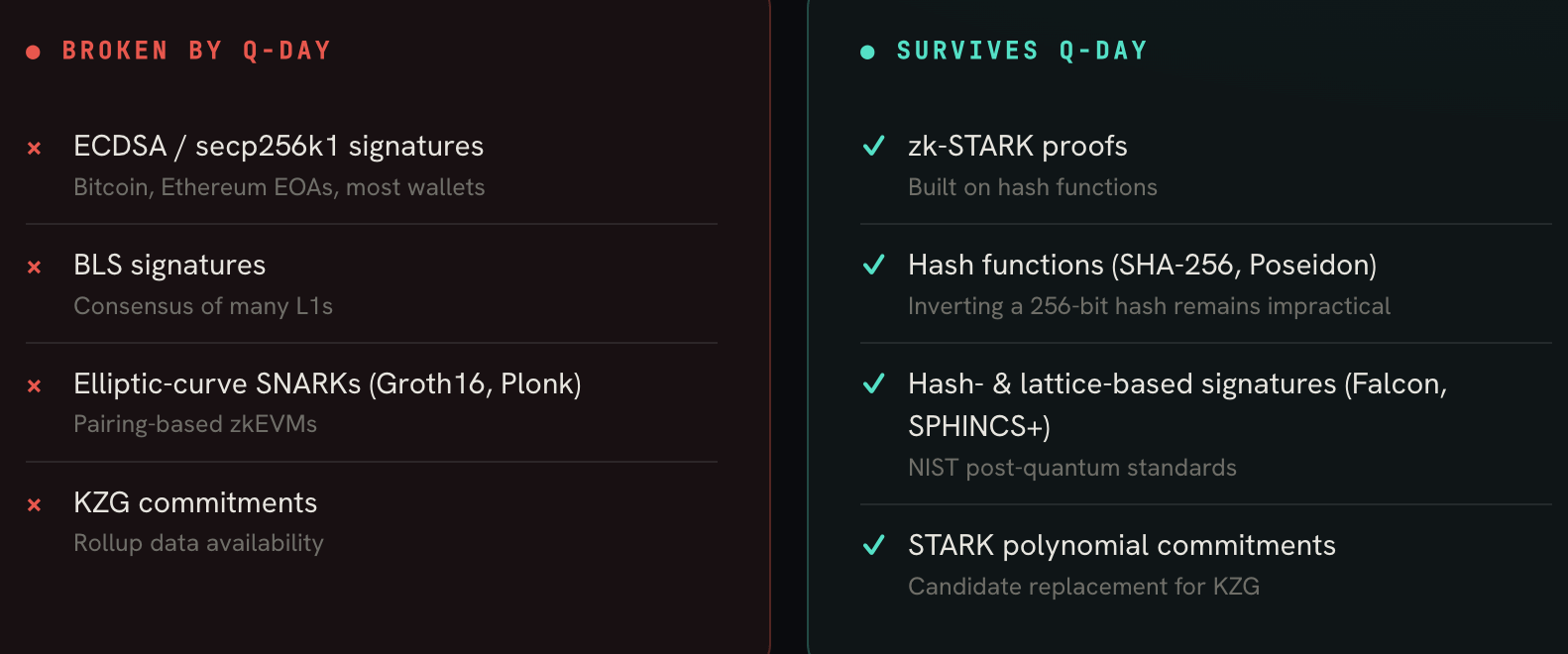
The line is clean: anything resting on elliptic curves falls, while anything resting on hash functions holds, because Grover’s algorithm only halves their effective security, which a larger output size restores. NIST finalized three post-quantum algorithms in 2024 (ML-KEM, ML-DSA, and SLH-DSA), giving the industry a shared foundation.
The question for every blockchain becomes purely architectural: which side of the line were you born on?
The solution: Starknet
Most networks will have to rebuild everything from scratch to become post-quantum secure.
They will need to replace their cryptographic primitives, force every user to migrate funds to new wallets, and coordinate hard forks. A massive cost, and a clear sign that most of crypto is still not thinking in decades.
Starknet approaches this transition with a structural advantage: its cryptographic core is already on the right side of the shift, and its architecture makes the remaining steps far less painful.
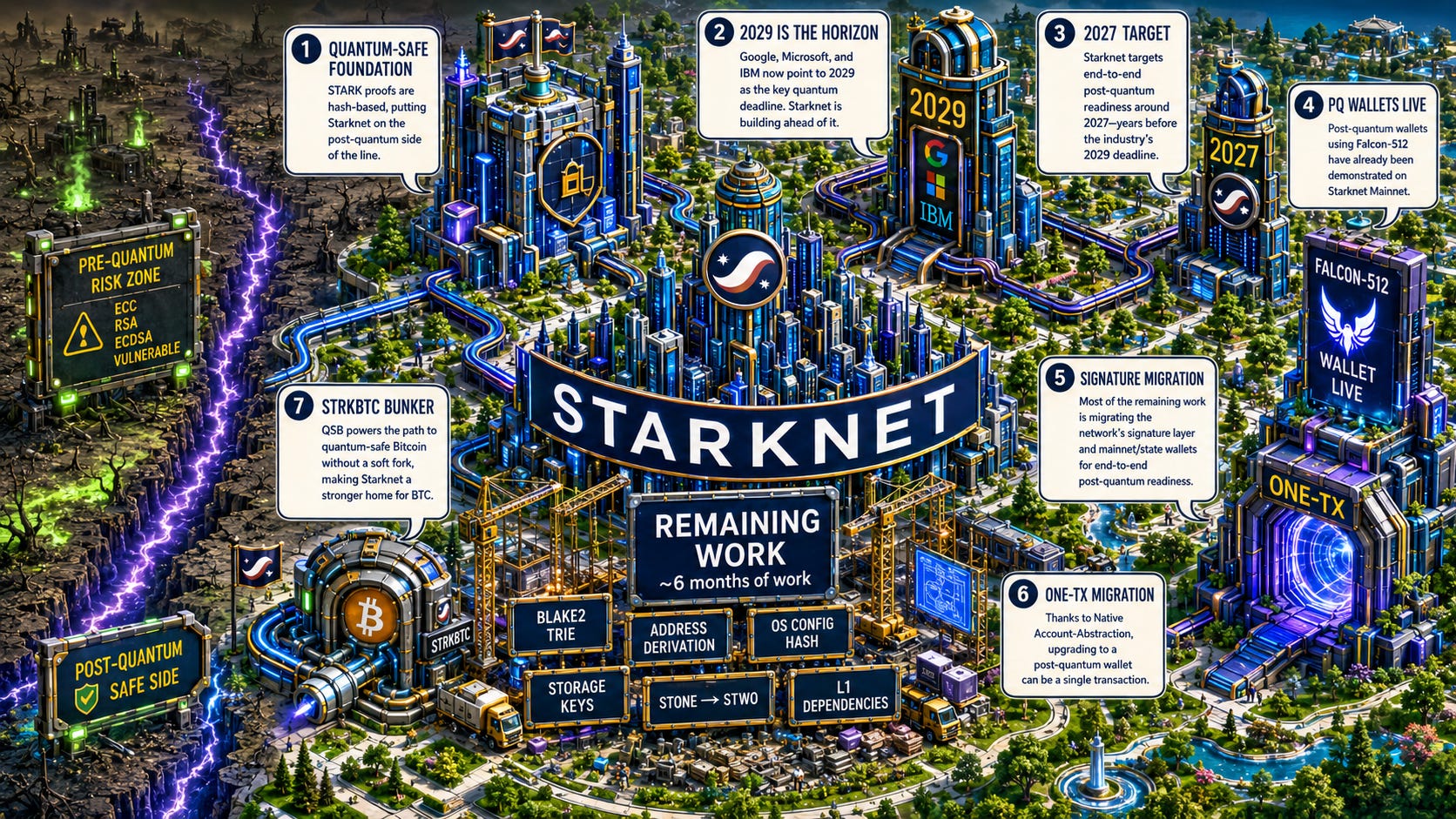
1. Natively post-quantum STARK proofs: Starknet is powered by STARK proofs, whose security relies on collision-resistant hash functions rather than elliptic curves. STARKs are widely recognized as quantum-resistant, meaning Starknet’s proof layer requires no reinvention, a point highlighted by Google itself.
2. Native account abstraction, the one-click migration: On most chains, wallets are externally owned accounts (EOAs) tied to a fixed key pair, so going post-quantum forces creating new wallets and moving all funds. On Starknet, every wallet is a smart contract. Adopting a post-quantum signature will be done with a simple wallet upgrade (a single transaction for users), with no protocol-level disruption and no mass migration.
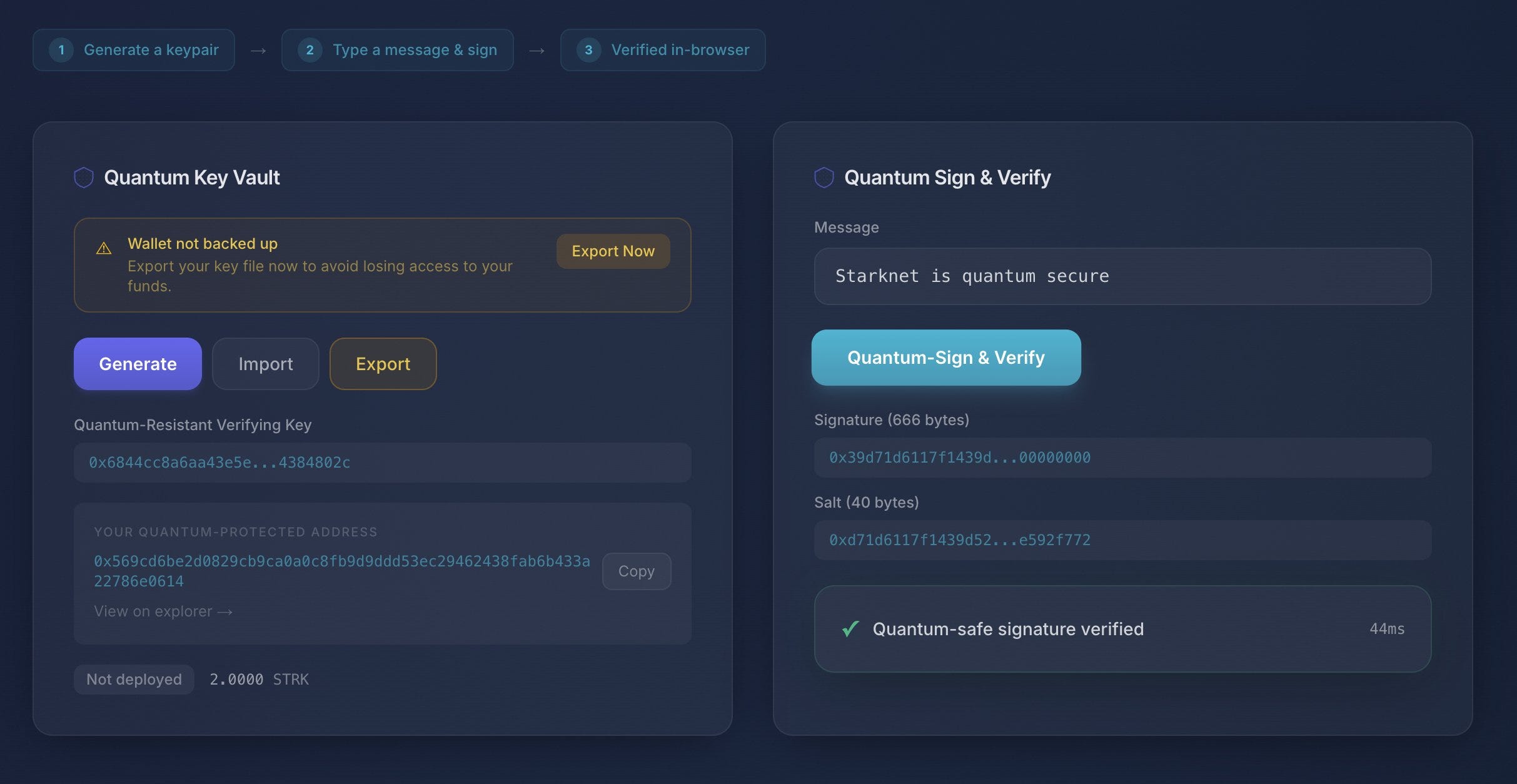
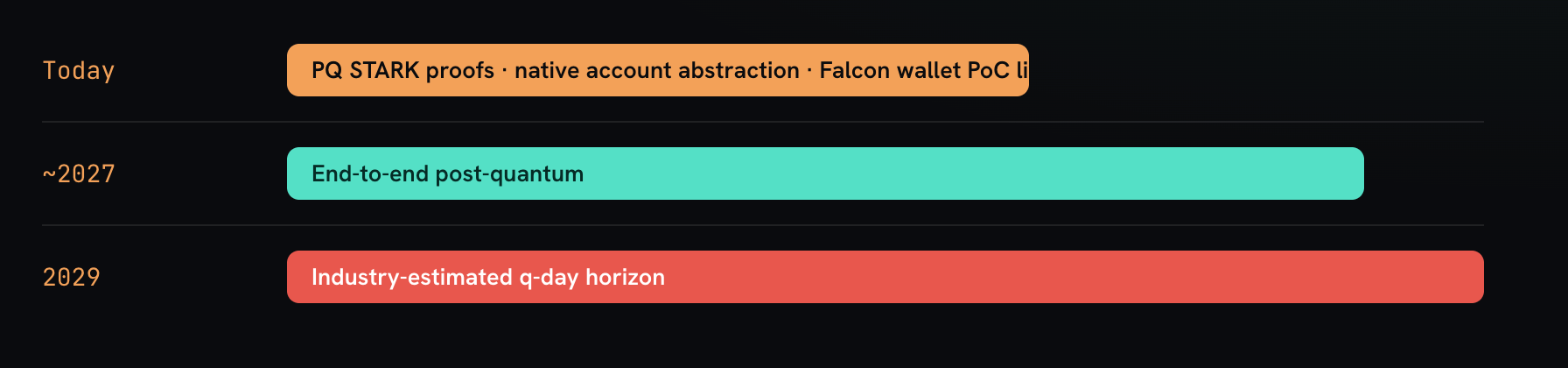
3. Post-quantum wallets already demonstrated on Mainnet: a working proof-of-concept of Falcon-512 (a NIST-selected post-quantum signature, being standardized as FN-DSA/FIPS 206) already runs on Starknet Mainnet. More on that topic here.
To be precise about what is not yet done: Starknet is not 100% post-quantum today. The remaining work spans a handful of surfaces across three phases. The Pedersen hash function, which is not quantum-safe, is being replaced by the quantum-resistant BLAKE2 across the state commitment, address derivation, and chain environment. Consensus signing moves from ECDSA to a post-quantum scheme such as Falcon-512, and mainstream wallet integration is still to be finalized. The last surfaces, the Ethereum bridge and blob data availability, are gated on Ethereum's own migration. But the foundations that are normally the most expensive to change, the proof system, are already on the right side. What remains is integration, not reinvention. That transition-cost differential is the moat.
Starknet’s stated goal for the remaining pieces is end-to-end post-quantum security around 2027, ahead of the 2029 horizon. A detailed roadmap will follow in the coming weeks.
Conclusion: Starknet is an asymmetric bet on the quantum threat
The market prices quantum as a distant risk. State capital, Google, and IBM price it as a 2029 risk. That gap is the opportunity.
If post-quantum security becomes a selection criterion for institutional capital, and it increasingly has to, now that the US government has ordered its own agencies to migrate high-value systems to post-quantum cryptography by 2030 and 2031, then the best-positioned asset is the one that can transition earliest and with the least friction.
The thesis does not require predicting the exact date of q-day. It requires only two recognitions:
that the quantum-security premium is not yet priced in,
and that Starknet holds the structural moat to capture it.
While the federal government runs its first government-wide post-quantum pilot through the end of 2027, Starknet’s target is to already be there.
I will repeat it again: Starknet will be fully post-quantum secure as early as 2027.
None of the content of this newsletter is financial advice. Always do your own research.